
- 9月 5, 2025
- Posted by: admin
- Category: Uncategorized
Baccarat generates substantial gaming revenue across global casino markets, particularly in Asian gaming destinations where the game dominates table gaming floors. The combination of high wagers, rapid game cycles, and complex betting patterns creates operational challenges that real-time RFID monitoring addresses comprehensively. Modern baccarat table monitoring systems leverage RFID technology to provide continuous oversight of every chip movement, bet placement, and game outcome, transforming operational visibility and control.
This analysis examines the architecture, capabilities, and operational benefits of real-time baccarat monitoring systems, with focus on implementation considerations for casino operators seeking to enhance table game management.
The Operational Challenge of Baccarat Management
Baccarat presents unique monitoring challenges compared to other table games. Understanding these challenges clarifies the value proposition of RFID-based monitoring systems.
High-Volume Transaction Processing
Baccarat games operate at high velocity, with rounds completing in approximately one minute under optimal conditions. Each round involves multiple bet types—Player, Banker, Tie, and often side bets—with each bet position potentially containing multiple chips from multiple players. A busy baccarat table may process hundreds of individual chip transactions per hour.
Manual monitoring cannot track this transaction volume with accuracy or completeness. Floor supervisors observing multiple tables capture only notable events—large bets, unusual patterns, or obvious irregularities—while the vast majority of transactions occur without detailed observation or recording.
Complex Commission Calculation
Banker bet winnings in baccarat are subject to commission, typically five percent of the winning amount. Commission calculation must be accurate for each winning Banker bet, accumulated correctly across sessions, and reconciled against cage records. Manual commission tracking introduces error opportunities that can compound over extended operations.

Commission errors create reconciliation discrepancies between table and cage, require investigation and correction labor, and can affect player relationships if errors are discovered after the fact. The repetitive nature of commission calculation also creates fatigue-induced errors during extended dealer shifts.
Multi-Position Betting Complexity
Baccarat tables accommodate multiple players betting on the same positions. Unlike blackjack where each player has a designated betting area, baccarat players place chips on communal bet positions for Player, Banker, Tie, and side bets. This shared betting arrangement creates challenges for tracking individual player wagers and outcomes.
Manual monitoring can estimate individual player betting based on chip placement patterns, but accurate attribution requires dealer memory or explicit annotation—both unreliable during busy game conditions. Player dispute resolution suffers when bet attribution cannot be verified definitively.
RFID Monitoring Architecture
Real-time baccarat monitoring systems employ RFID technology integrated into table construction, gaming chips, and operational software to capture comprehensive transaction data without manual intervention.
Table-Embedded Sensor Arrays
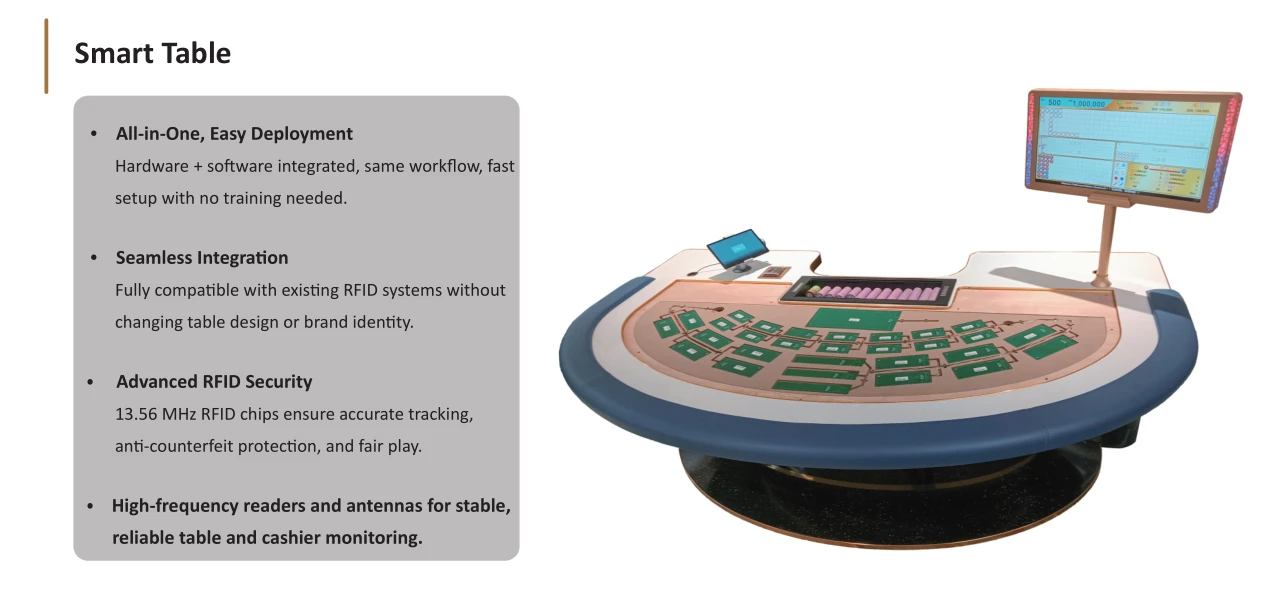
RFID-enabled baccarat tables incorporate sensor antenna arrays embedded beneath the table surface in each betting position. These antennas create radio frequency interrogation fields that detect and identify RFID chips placed within the betting areas. Antenna design ensures coverage across the entire betting position, including overlapping chip stacks, while maintaining separation between adjacent positions.
The sensor array connects to reader electronics that sequentially activate each antenna, interrogate chips within each position, and report the detected chip identities to the monitoring system. Reader timing is optimized to capture complete betting information after the betting period closes but before cards are revealed, enabling bet verification against game rules.
Chip-Level Transaction Tracking
Each RFID-enabled chip in play carries a unique electronic identifier that the monitoring system associates with denomination value and ownership. As chips move through table operations—purchased from the cage, bet at the table, won or lost based on game outcomes, and returned to the cage or carried to other tables—the monitoring system tracks each chip’s location and transaction history.
This granular tracking enables capabilities impossible with visual monitoring: exact bet composition at each position, individual player wager tracking despite shared betting areas, and comprehensive chip movement records that support investigation and reconciliation Smart Gaming Table.
Real-Time Data Processing Architecture
The monitoring system architecture processes RFID data in real-time, transforming raw chip detection events into operational intelligence. Key processing stages include:
Signal Processing and Noise Filtering converts raw antenna signals into reliable chip detection events, filtering out environmental noise, cross-talk between adjacent antennas, and transient detection artifacts.
Position Attribution assigns detected chips to betting positions based on the antenna that detected each chip, handling edge cases where chips may be detected by multiple antennas due to physical placement near position boundaries.
Betting State Assembly combines chip detections from all positions to create a complete picture of the betting state at each monitoring instant, tracking how betting evolves during the betting period and settling into the final bet configuration.
Outcome Correlation integrates betting state with game outcome information from card recognition systems or dealer input, associating each bet with its result and calculating wins, losses, and commissions.
Transaction Recording logs every detected event—chip placements, bet outcomes, commission calculations—in the operational database, creating the comprehensive audit trail required for reconciliation, investigation, and analysis.
Core Monitoring Capabilities
Real-time baccarat monitoring delivers operational capabilities across security, efficiency, and player service dimensions.
Bet Verification and Game Integrity
The monitoring system verifies that bet placements conform to game rules and house policies. Verification includes checking that bets are placed within designated areas, detecting late bets placed after the betting period closes, confirming minimum and maximum bet compliance, and validating side bet eligibility based on main bet presence.
When rule violations are detected, the system alerts floor supervisors in real-time, enabling immediate intervention before game outcomes are determined. This proactive verification prevents the disputes and investigations that result from rule violations discovered after the fact.
Commission Calculation and Tracking
Automated commission calculation eliminates manual errors and provides continuous commission accumulation. The system calculates commission for each winning Banker bet based on the exact win amount, accumulates commission across the session, and provides running totals for reconciliation against cage records.
Commission tracking reports support end-of-shift reconciliation by providing commission totals by table, dealer, and time period. Discrepancies between table and cage records can be investigated by reviewing detailed commission logs that show every commission event contributing to the totals.
Player Betting Pattern Analysis
The monitoring system tracks individual player betting behavior by associating chip movements with player identities. Player identification can be achieved through loyalty card integration, chip purchase records, or dealer input. With player attribution, the system analyzes betting patterns including average bet size, bet type preferences, session duration, and outcome impact.
Betting pattern analysis supports multiple operational objectives: identifying high-value players for attention and retention, detecting unusual betting patterns that may indicate advantage play or collusion, and providing personalized service based on individual player preferences and history.
Security and Fraud Detection
RFID monitoring enhances security through continuous observation of every chip transaction. Security capabilities include detecting chip authentication anomalies that indicate counterfeit tokens, identifying betting patterns associated with past-posting or other cheating methodologies, and tracking chip movements that may indicate money laundering or structuring.
The comprehensive transaction record supports investigation by providing definitive evidence of what occurred at the table, when events happened, and which individuals were involved. This evidence capability reduces investigation time and increases investigation accuracy compared to reliance on witness recollection and surveillance video review.
Operational Integration and Workflow
Real-time monitoring value is realized through integration with casino operational workflows and management systems.
Floor Supervisor Decision Support
Floor supervisors receive real-time information displays that summarize table activity and highlight notable events requiring attention. Information includes current table action levels, recent large bets, player identification for key patrons, and system alerts for rule violations or security concerns.
This information support enables supervisors to allocate attention effectively across multiple tables, focusing on situations requiring intervention while maintaining awareness of overall floor activity. Decision support reduces supervisor cognitive load and improves response time to emerging situations.
Dealer Performance Monitoring
Monitoring data provides objective measures of dealer performance including game pace, accuracy in chip handling and payout, and compliance with procedures. Performance metrics support coaching conversations and training program development by identifying specific areas where individual dealers can improve.
Objective performance data also supports fair evaluation and recognition programs, rewarding dealers who maintain high performance standards while providing development support for dealers who need improvement.
Cage and Treasury Integration
Integration between table monitoring and cage systems enables automated reconciliation of chip movements between table and cage. Chips issued from the cage are associated with destination tables, chips returned from tables are verified against table records, and discrepancies trigger investigation rather than remaining hidden until periodic audits.
Real-time cage integration also supports cash management by providing visibility into table chip inventories across the floor, enabling proactive chip supply management that prevents table operations disruption due to chip shortages.
Surveillance System Enhancement
RFID monitoring data integrates with surveillance systems to provide synchronized visibility into table operations. Surveillance operators can view RFID-detected bet states alongside video feeds, enabling verification of what transactions occurred while observing how they occurred. This combined visibility accelerates investigation and improves evidentiary quality.
Integration also enables surveillance search capabilities based on RFID events—identifying all video segments where a specific chip was involved in a transaction, or locating all occurrences of bets exceeding a threshold amount.
Technical Implementation Considerations
Successful real-time baccarat monitoring deployment requires attention to technical implementation factors that determine system performance and reliability.
Antenna Design and Placement
Antenna characteristics determine detection accuracy and reliability. Antenna size must cover the betting area comprehensively while maintaining sufficient resolution to distinguish chip positions. Antenna placement must account for table construction materials that affect radio frequency propagation. Antenna tuning must optimize for the specific chip transponders used in the operation.
Poor antenna design results in missed detections, false detections, or position attribution errors that undermine monitoring system value. Antenna optimization during installation and periodic recalibration during operation ensure sustained performance.
Environmental Interference Management
Casino environments present radio frequency challenges including metal table frames, electronic equipment, lighting systems, and human bodies that can affect RFID detection. Environmental assessment during system design identifies potential interference sources and guides mitigation approaches.
Mitigation techniques include antenna shielding, frequency selection, power level optimization, and signal processing algorithms that distinguish valid chip detections from environmental noise. Ongoing environmental monitoring detects changes that may affect system performance, enabling proactive adjustment.
System Reliability and Redundancy
Monitoring systems must operate continuously during all gaming hours. System architecture should include redundancy at critical points—power supplies, network connections, processing units—to prevent single points of failure from causing system-wide outages.
Failure detection and alerting enable rapid response to component failures, while fallback procedures maintain operational capability during partial system failures. Graceful degradation design ensures that failures result in reduced capability rather than complete system loss.
Data Management and Analytics
Real-time monitoring generates substantial transaction data that creates value through analysis and reporting.
Transaction Database Architecture
Transaction data accumulates rapidly—each chip detection, bet outcome, and game event generates database records. Database architecture must support high-volume data ingestion while maintaining query performance for operational reporting and investigation.
Data retention policies balance storage costs against historical analysis requirements. Typical retention periods range from one to seven years depending on regulatory requirements and analytical objectives. Archived data provides the foundation for trend analysis, pattern identification, and operational optimization.
Reporting and Dashboard Design
Operational reports transform transaction data into actionable intelligence. Report categories include real-time operational dashboards showing current table states, shift summary reports for end-of-session reconciliation, exception reports highlighting unusual events requiring investigation, and trend reports analyzing patterns over extended periods.
Report design should match information presentation to user roles and decision needs. Floor supervisors need different information than casino managers, who need different information than compliance officers. Tailored reports ensure that each user receives relevant information without information overload.
Advanced Analytics Applications
Transaction data supports advanced analytics applications including predictive modeling for table demand, anomaly detection for security enhancement, and player behavior analysis for marketing optimization. These applications extend monitoring system value beyond operational visibility into strategic intelligence.
Machine learning algorithms can identify patterns in transaction data that human analysts would not detect, such as subtle betting pattern changes that predict player departure or behavioral sequences associated with advantage play. Analytics sophistication grows as accumulated transaction data provides training examples for algorithm development.
Implementation Strategy and Timeline
Real-time baccarat monitoring implementation follows a phased approach that builds capability incrementally while managing risk.
Assessment and Planning Phase
Initial assessment evaluates current operations, identifies specific monitoring objectives, and defines success metrics. Planning establishes system architecture, selects technology partners, and develops implementation timeline and budget.
Pilot Implementation Phase
Pilot deployment on a limited number of tables validates technology performance, refines operational procedures, and builds staff proficiency. Pilot duration allows sufficient time to encounter varied operational conditions and resolve issues before broader deployment.
Full Deployment Phase
Full deployment extends monitoring capability across all baccarat tables, integrates with all relevant casino systems, and transitions to standard operations. Training programs ensure all affected staff understand system capabilities and procedures.
Optimization Phase
Post-deployment optimization refines system configuration based on operational experience, develops advanced reporting and analytics capabilities, and identifies enhancement opportunities for future implementation.
FAQ
How does real-time baccarat monitoring differ from traditional surveillance?
Real-time RFID monitoring captures every chip transaction with precision timing, while traditional surveillance provides video observation that may miss transaction details and requires manual review to extract information.
Can RFID monitoring track individual player bets in baccarat?
Yes, through player identification methods such as loyalty card integration or chip purchase records, the system attributes chips to specific players despite the shared betting positions in baccarat.
What commission calculation accuracy can monitoring systems achieve?
Automated commission calculation eliminates manual errors and achieves accuracy determined by chip denomination recognition, typically exceeding 99.9 percent for standard chip configurations.
How do monitoring systems handle chip stacks in betting positions?
Antenna arrays and reader algorithms detect all chips in a stack by reading each chip’s identifier, with signal processing accounting for attenuation through upper chip layers.
What is the typical implementation timeline for baccarat monitoring systems?
Full implementation typically requires six to twelve months from assessment through deployment, with pilot phases lasting two to four months depending on operational complexity.
Can existing baccarat tables be retrofitted with RFID monitoring?
Retrofit is possible for many table designs, though installation complexity varies. New table construction with integrated RFID infrastructure often provides optimal performance and lower installation cost.
How do monitoring systems affect game pace?
Properly implemented systems operate transparently during normal game flow, with detection occurring during standard game pauses such as the betting period closure before card reveal Macaumr.
What training do dealers and floor staff need?
Training covers system understanding, procedure compliance, alert response protocols, and fallback procedures. Typical training programs require four to eight hours per role.
How do monitoring systems integrate with existing casino management systems?
Integration uses standard APIs and data formats to connect monitoring systems with cage management, player tracking, surveillance, and reporting platforms.
What is the typical return on investment timeline?
ROI timelines vary by operation scale and monitoring objectives, with typical payback periods of two to four years from error reduction, security enhancement, and operational efficiency gains.


